

 Image 1 of 1
Convergence of Vision
Professional Acrylic on Canvas
Size: 39 × 72 inches (Triptych)
Style: Impressionism • Cubism • Abstract Expressionism
Presentation: Three-panel gallery-wrapped canvas, museum quality
A Collector's Promise
The One-of-One Declaration
These three paintings were created with a single purpose: to unite three of history's greatest artistic movements into entirely original contemporary compositions.
Each work is completely unique.
Only one original of each composition exists, and only one ever will. No second original will be painted. No alternate composition will be created. Once acquired, the concept is permanently retired from the artist's studio.
The collector becomes the sole owner of a work that exists nowhere else in the world.
This is more than owning an original painting—it is preserving a singular artistic statement that can never be duplicated.
One Composition. One Original. One Collector. Forever.
Description
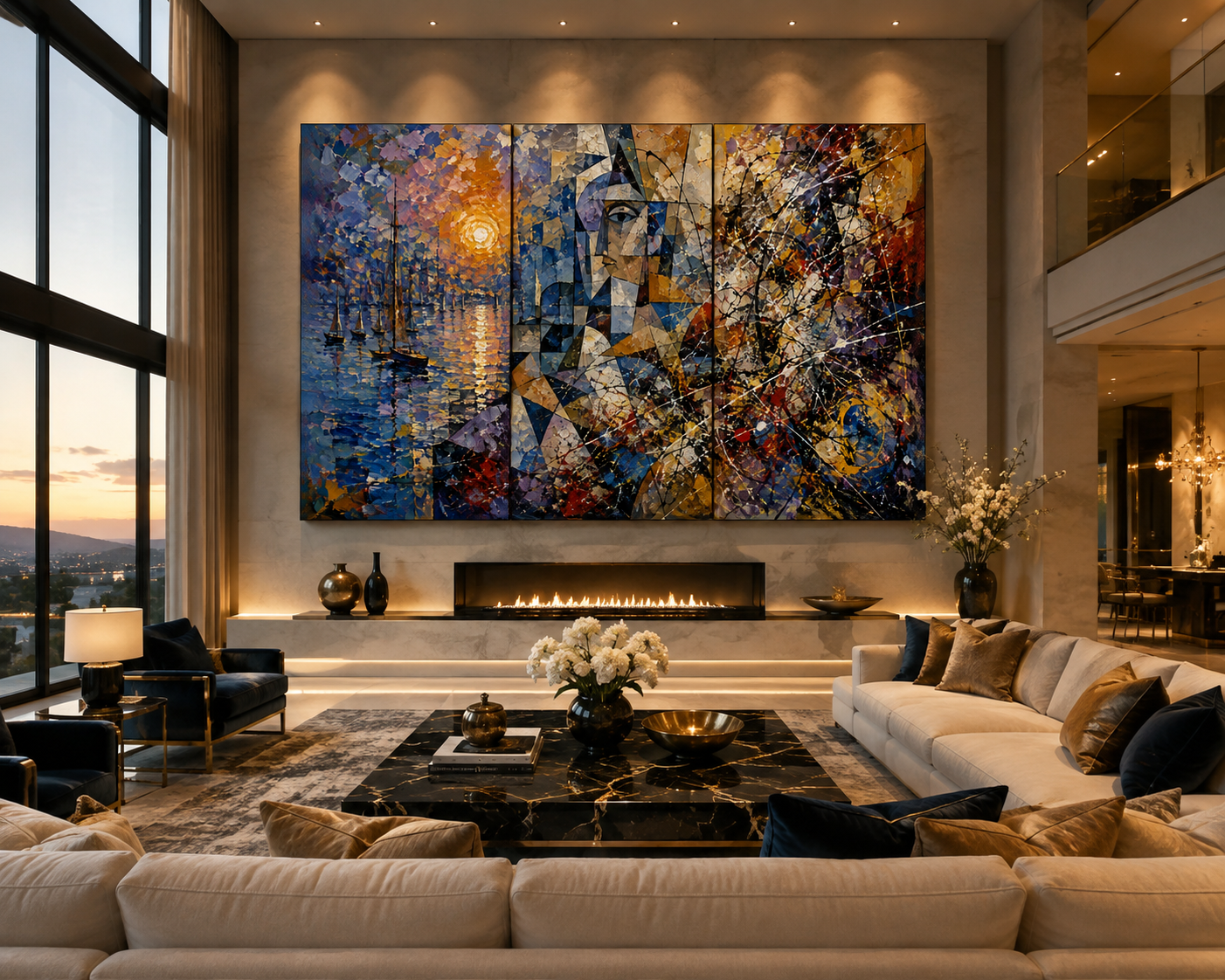
Convergence of Vision is a celebration of three of the most influential artistic movements ever created, woven into a single visual journey. Rather than separating these revolutionary styles, the composition allows them to flow seamlessly together, revealing how each movement expanded the language of art while building upon the ideas that came before.
The left panel embraces the luminous atmosphere of Impressionism, where shimmering light, reflected water, and expressive color capture the fleeting beauty of a moment. As the eye moves toward the center, the composition transforms into the geometric architecture of Cubism. Fragmented planes, intersecting forms, and shifting perspectives invite the viewer to experience reality from multiple viewpoints simultaneously.
The final panel erupts into the uninhibited energy of Abstract Expressionism. Sweeping gestures, layered textures, and spontaneous lines dissolve recognizable form into pure emotion, allowing movement itself to become the subject. Here, intellect gives way to instinct, and structure gives way to freedom.
Although each section speaks its own artistic language, they are united by a carefully orchestrated palette of sapphire blues, warm golds, deep umbers, ivory, crimson, charcoal, and soft violet. Color becomes the bridge that allows the three movements to coexist as one continuous composition rather than three separate paintings.
Convergence of Vision represents more than the evolution of modern art—it reflects the evolution of human creativity itself. Observation becomes analysis, analysis becomes emotion, and emotion ultimately becomes expression. It is both a tribute to the masters who transformed art history and a contemporary interpretation that demonstrates how innovation continues to emerge when seemingly different ideas are brought together in harmony.
The result is a commanding museum-quality statement piece that rewards repeated viewing, revealing new relationships between color, form, light, and movement with every encounter. It is a painting that invites viewers not only to appreciate three artistic revolutions but to experience them as one unified visual symphony.
Professional Acrylic on Canvas
Size: 39 × 72 inches (Triptych)
Style: Impressionism • Cubism • Abstract Expressionism
Presentation: Three-panel gallery-wrapped canvas, museum quality
A Collector's Promise
The One-of-One Declaration
These three paintings were created with a single purpose: to unite three of history's greatest artistic movements into entirely original contemporary compositions.
Each work is completely unique.
Only one original of each composition exists, and only one ever will. No second original will be painted. No alternate composition will be created. Once acquired, the concept is permanently retired from the artist's studio.
The collector becomes the sole owner of a work that exists nowhere else in the world.
This is more than owning an original painting—it is preserving a singular artistic statement that can never be duplicated.
One Composition. One Original. One Collector. Forever.
Description
Convergence of Vision is a celebration of three of the most influential artistic movements ever created, woven into a single visual journey. Rather than separating these revolutionary styles, the composition allows them to flow seamlessly together, revealing how each movement expanded the language of art while building upon the ideas that came before.
The left panel embraces the luminous atmosphere of Impressionism, where shimmering light, reflected water, and expressive color capture the fleeting beauty of a moment. As the eye moves toward the center, the composition transforms into the geometric architecture of Cubism. Fragmented planes, intersecting forms, and shifting perspectives invite the viewer to experience reality from multiple viewpoints simultaneously.
The final panel erupts into the uninhibited energy of Abstract Expressionism. Sweeping gestures, layered textures, and spontaneous lines dissolve recognizable form into pure emotion, allowing movement itself to become the subject. Here, intellect gives way to instinct, and structure gives way to freedom.
Although each section speaks its own artistic language, they are united by a carefully orchestrated palette of sapphire blues, warm golds, deep umbers, ivory, crimson, charcoal, and soft violet. Color becomes the bridge that allows the three movements to coexist as one continuous composition rather than three separate paintings.
Convergence of Vision represents more than the evolution of modern art—it reflects the evolution of human creativity itself. Observation becomes analysis, analysis becomes emotion, and emotion ultimately becomes expression. It is both a tribute to the masters who transformed art history and a contemporary interpretation that demonstrates how innovation continues to emerge when seemingly different ideas are brought together in harmony.
The result is a commanding museum-quality statement piece that rewards repeated viewing, revealing new relationships between color, form, light, and movement with every encounter. It is a painting that invites viewers not only to appreciate three artistic revolutions but to experience them as one unified visual symphony.